What we did
What Lev Up runs on now
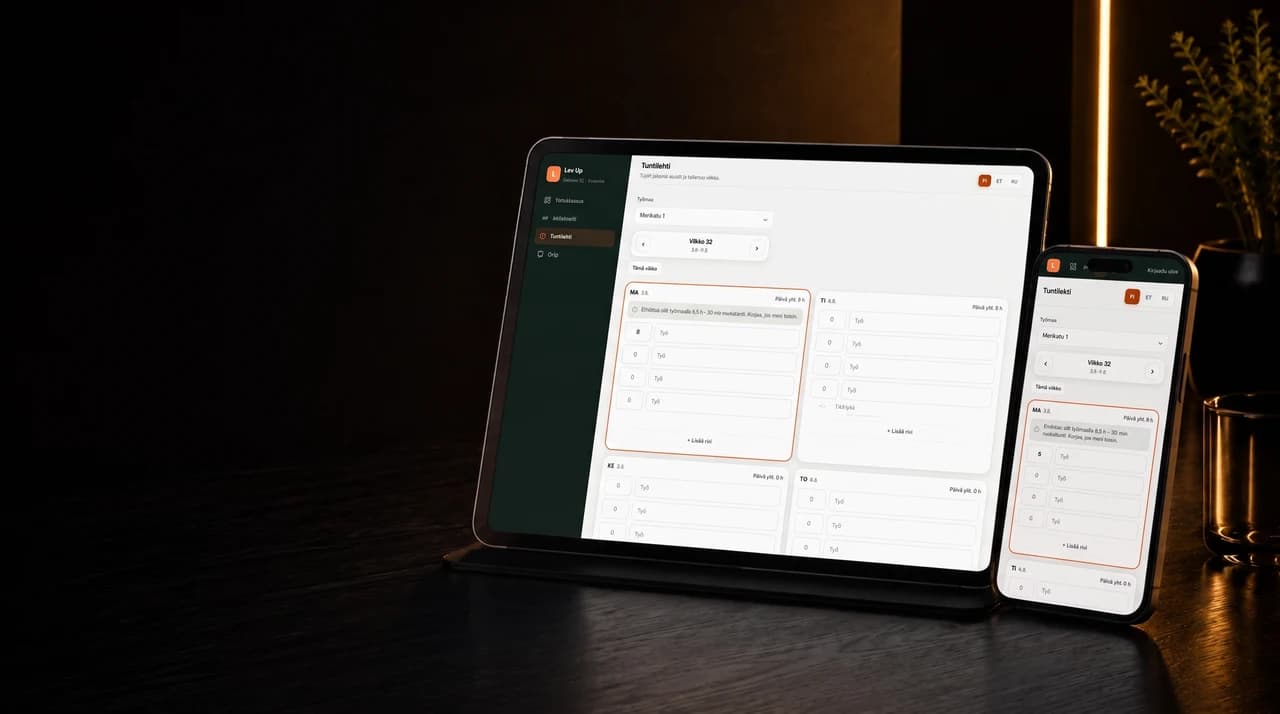
Lev Up Maalaus is a painting contractor whose crews speak Finnish, Estonian and Russian. We built the company its own app, where clock-ins, weekly hours and site figures live in one place. It has been in daily use since June 2026.
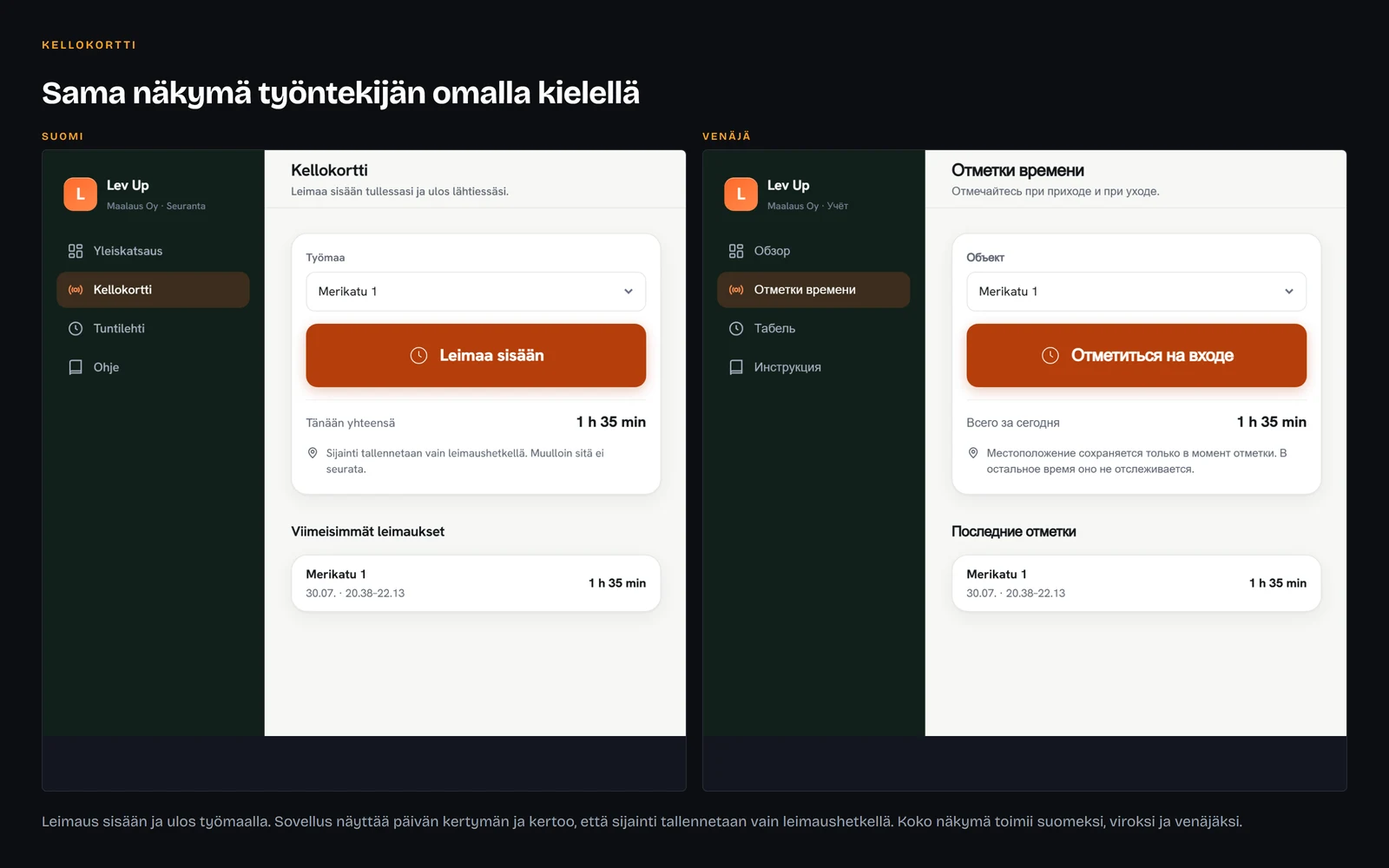
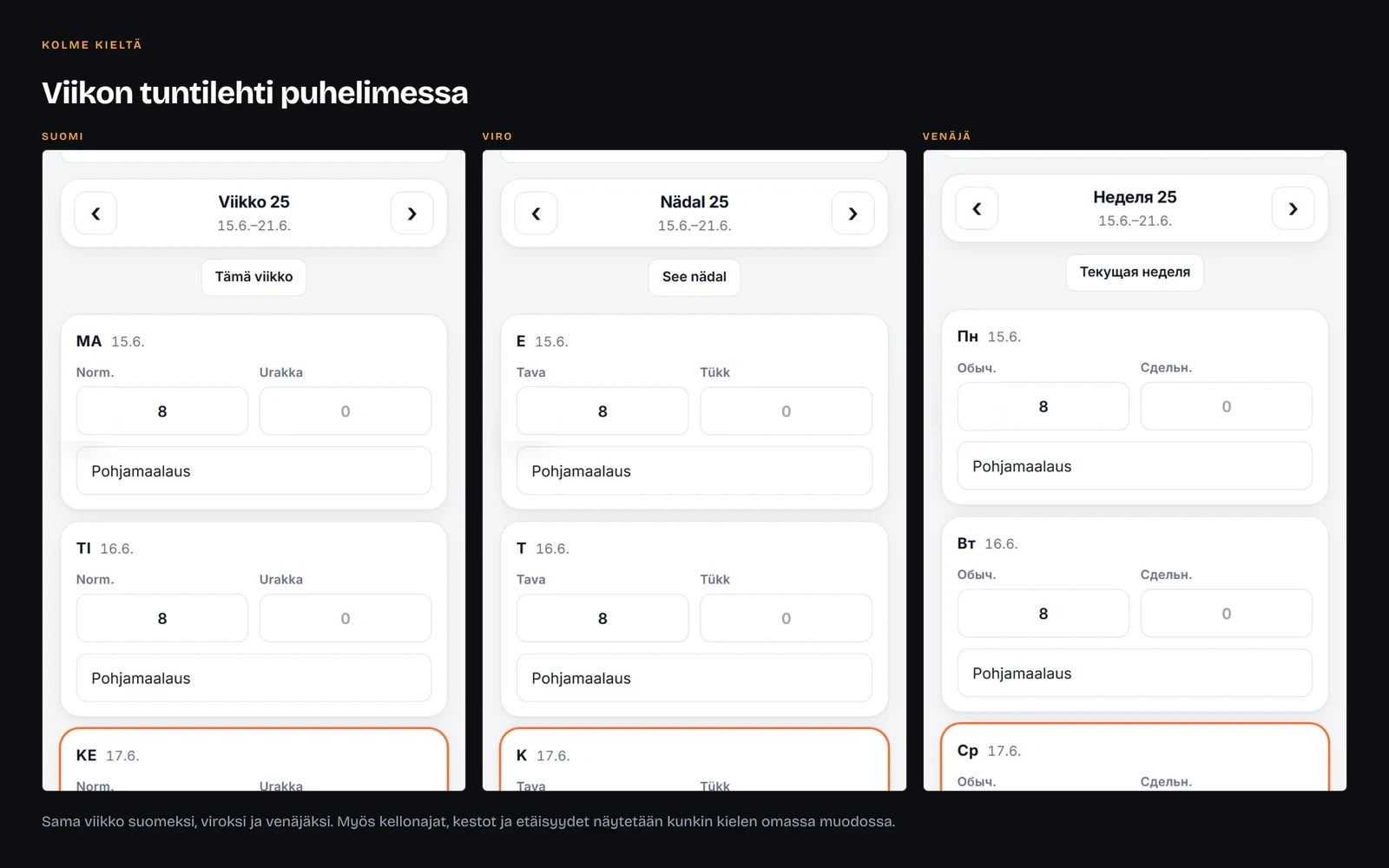
- Everyone works in their own language. The worker view, the guides and the error messages are in Finnish, Estonian and Russian. Times, durations and distances are formatted per language as well, so a Russian-speaking painter reads 340 м and 7 ч 12 мин on screen.
- Clocking in on site. A worker clocks in and out from a phone, and the app shows the location, the distance to the site and a map. A shift left open for more than 12 hours closes itself, so a forgotten clock-out does not stay open.
- Weekly hours on the phone. The worker picks a name, types a four-digit PIN and fills in seven day cards with hours, overtime hours and a short note about the day. Salaries and margins stay out of that view.
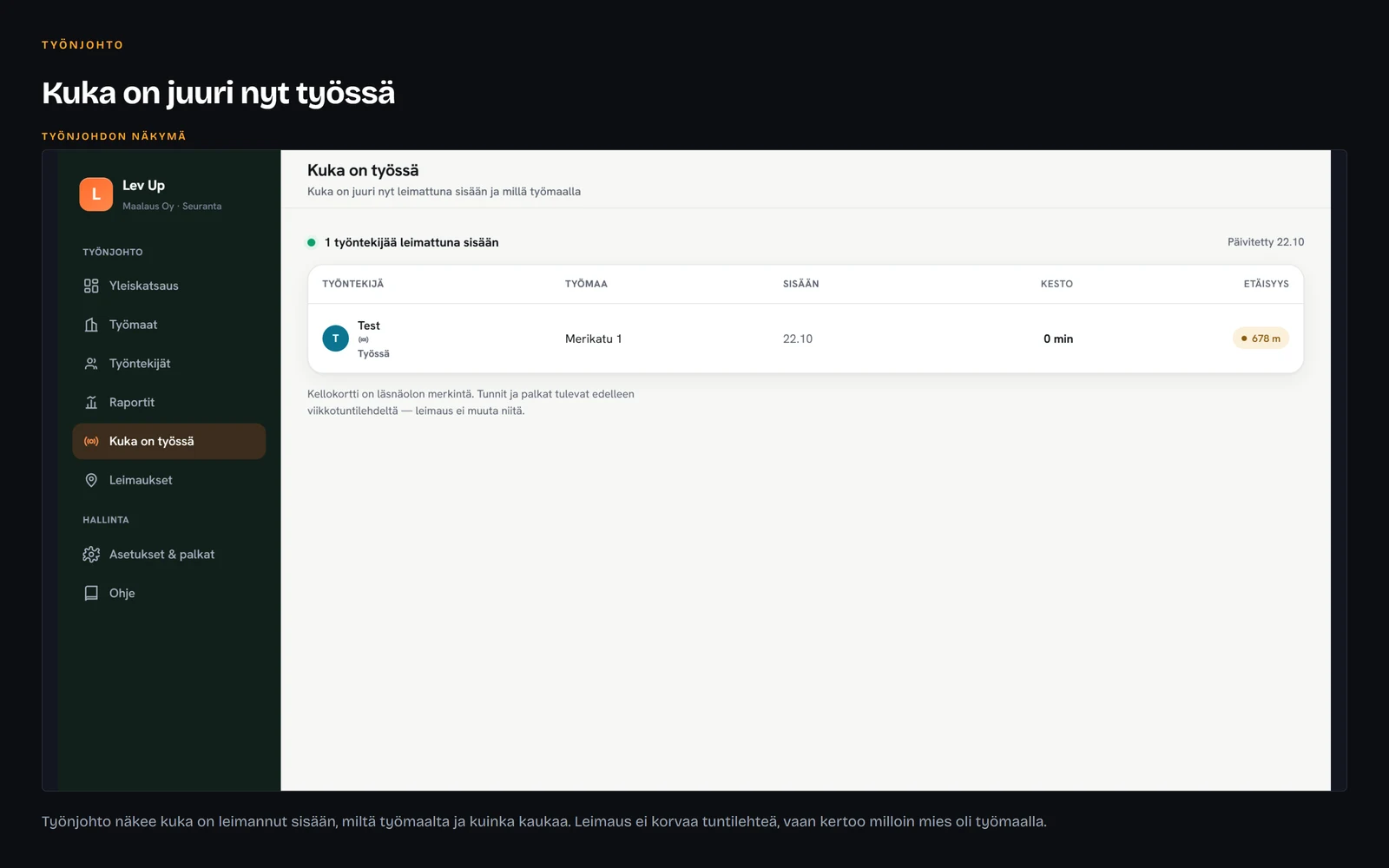
- The whole picture for the supervisor. A separate view shows who is at work right now. Each site carries its hours, other costs, invoicing, margin and status, and a single worker's days open from the same place.
- Reports that end up in Excel. A report can cover a ready-made period or a free date range and be filtered by site or worker. Rows open down to a single day, and two CSV files come out that open correctly in Finnish Excel.
The lunch break shows how we work
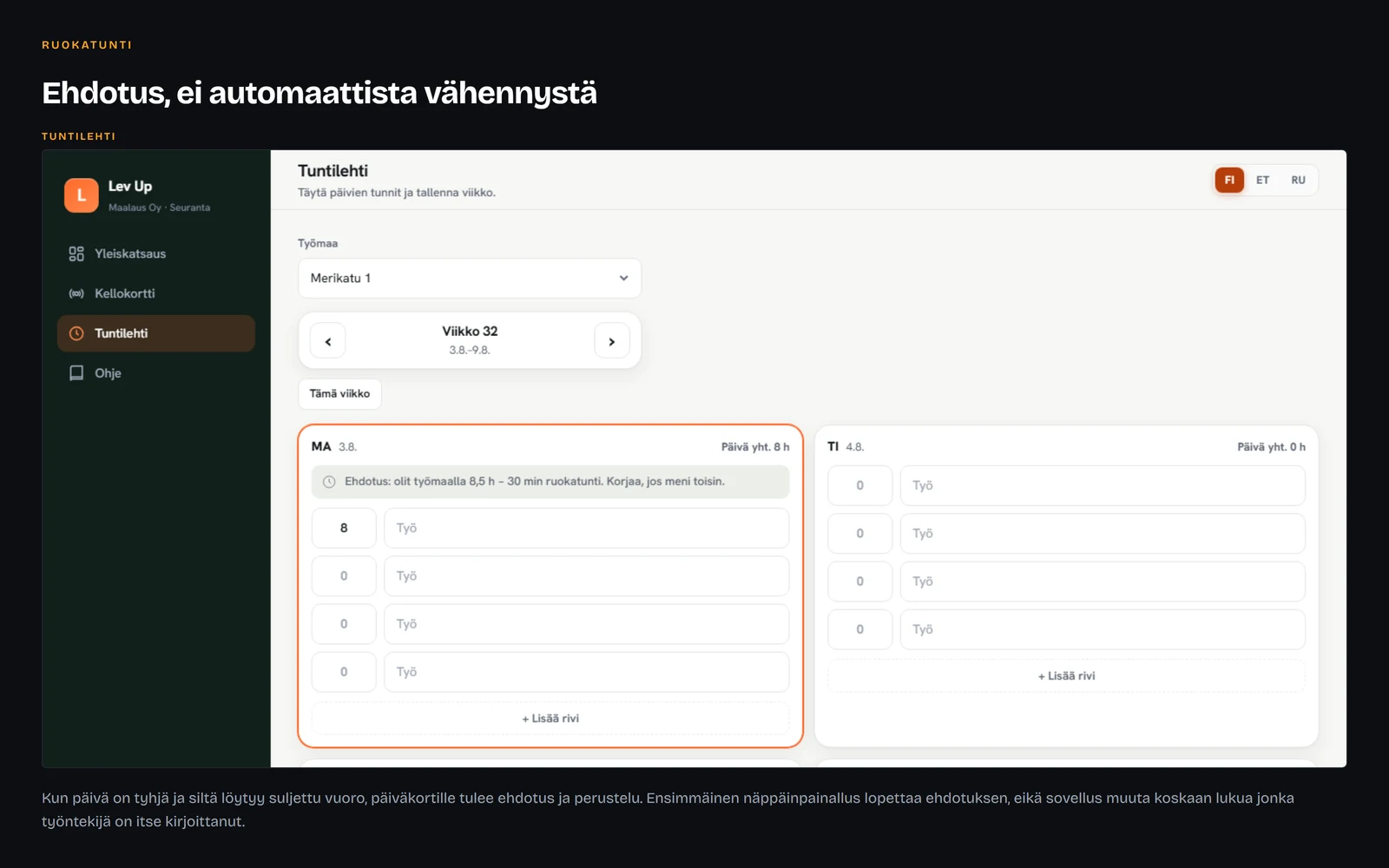
Off-the-shelf software would deduct half an hour automatically whenever the day runs long enough. At Lev Up that would be the wrong call, because the crew already deducts the lunch break before writing the hours down. An automatic deduction would take the same half hour a second time, every day, from every painter.
So the app deducts nothing. It suggests, and it says where the number came from. When a day is empty and a closed shift exists for it, the day card carries a line that reads “you were on site for 8.5 h, minus a 30 minute lunch break. Correct it if the day went differently.” The first keystroke ends the suggestion. A number the worker has written is never overwritten by the app.
The 6:55 rule belongs to the client
At Lev Up the working day starts at 6:55 on every site. Some of the crew are at the gate before that, and the app stores the clock-in exactly as it happened, because that stamp is the record of when the work was done. 6:41 stays 6:41. The calculation still starts at 6:55, because that is what Lev Up has agreed with its people. The rule is theirs, not ours.
The same principle covers late entries. There is a 24-hour window, and a row entered afterwards is marked for the supervisor. The clock that decides is the server's, not the phone's.
The data belongs to Lev Up
Lev Up's data sits in its own database in a Stockholm data centre, not next to another client's, and a backup is taken every day. The browser never reaches the database directly. Every query goes through the server, and every supervisor action checks permissions separately.
Location data is deleted automatically after 12 months. Times and durations stay, coordinates do not. The worker guide says so in all three languages, because a person is entitled to know, in their own language, what is stored about them and for how long.
The worker views were run through an automated accessibility check at three screen widths, and it flagged nothing. An automated check only finds part of the problems, so we do not call it a certificate. Buttons were made at least 44 pixels, because on site people tap with gloves on. On site a phone gets used in a hurry and often with cold hands, so button size is not a matter of taste.
If your sites run in three languages and the counting rules are your own, off-the-shelf software starts from the wrong end.
Clock-ins, weekly hours and site figures live in one place in three languages, and the counting follows Lev Up's own rules.
Results in numbers
A look at the work
Do you have a similar project?
Tell us what you have in mind. We reply within one working day.